Eldon Mate's North Vista apartment
Dr. DeathEldon Mate's North Vista apartment, in an upper-floor duplex between Sunset and Hollywood, becomes more than the address of a murder victim: on a return visit, its apparently undisturbed interior yields a hollow Beowulf prop that was not there during an earlier search. The building’s neglected entrance, the apartment’s accumulated dust and books, and the unexplained new object turn the location itself into evidence about access, staging, and a killer’s possible return.
Setting and Building
The apartment occupies the upper level of a seventy-year-old duplex on North Vista. The landlady, Mrs. Ednalynn Krohnfeld, lives below. She is described as tiny and elderly, walking stiffly and wearing twin hearing aids. When Alex Delaware and Milo Sturgis enter, she returns to her chair, draws a crocheted brown throw over her knees, and concentrates on a sixty-inch Mitsubishi television. Its badly rendered skin tones cast the people on screen in an exaggerated orange, while a combative talk show fills the room with curses and bleeps. The downstairs scene establishes an everyday domestic space beside the crime investigation, but Mrs. Krohnfeld does not respond when Milo tells her they have come to look at the apartment again.
The duplex’s two levels have distinct interiors. Mrs. Krohnfeld’s television and chair belong to the downstairs front room; Mate’s bookshelves and bedroom furniture are encountered upstairs. The apartment’s location in a busy Hollywood neighborhood also matters to the investigation: Milo considers whether a nearby novelty shop might have sold the suspicious object, while Alex later reasons that a killer familiar with the area could have recruited someone from the street to deliver a package.
Entry and the Search
On the return visit, the approach to Mate’s front door is marked by a small overhang and fast-food advertisements scattered across the floor. Yellow police tape still bands the plain wooden door, but it offers little real security. Milo pulls it away and opens the door with a single turn of the key; the lock is not a dead bolt, and the door could have been kicked in. The contrast between the visible seal and the weak lock makes the apartment’s boundary seem more official than secure. The tape can signal a crime scene, but it cannot establish who has entered or when.
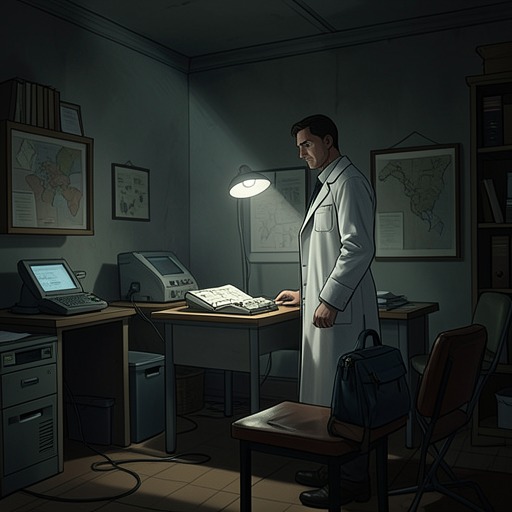
Inside, the air is described through the accumulated signs of neglect: mold, must, rot, and decaying paper. When Milo opens the ancient Venetian blinds, the light reveals dust stirred into visible clouds as the investigators move through the tight, shadowed rooms. The apartment is not a pristine, controlled scene. Its many books and its stale atmosphere make careful comparison difficult, while the easy entry leaves open the possibility that someone has returned unseen.
The bedroom search moves through Mate’s dresser. Its upper drawer holds folded white underwear and rolled black socks; the next contains brown and gray cardigans, and the drawer below is full of medical books. In the lowest drawer are four hardbacks. The first three have warped bindings, and one prompts a check of its 1934 copyright. This ordinary-looking collection gives way to the discovery that changes the meaning of the search: the fourth volume is not quite a book at all.
The Hollow Beowulf
The small fourth item is bound in shiny ruby-red leatherette, with gold-colored tooling and ornate lettering on its ribbed spine. It purports to be a collector’s edition of Beowulf from the Literary Gem Society, but it is too light for a real book and rattles when handled. Inside, there are no pages: the cover opens onto a hollow Masonite compartment, with a Made in Taiwan label on the underside of the lid. Its convincing decorative exterior disguises its actual function as a container.
The object’s significance rests especially on its timing. Milo says that during his first thorough search, the other books were already in the drawer but this one was not. He recalls checking their copyrights, which makes the newly present prop difficult to dismiss as something he simply overlooked. The apartment therefore changes from a place already searched into a potentially revisited scene. Someone may have entered after the murder and added an object meant to be noticed, although the discovery alone does not establish who placed it there or why.
The hollow volume also echoes the crime’s medical context without resolving it. Alex considers whether a visitor left it as a commemoration, possibly alongside the broken stethoscope associated with the case, and imagines the message as an assertion that Mate’s work has ended and someone else has taken his place. These are investigative interpretations, not confirmed meanings. The book’s emptiness, disguise, and unexplained arrival make it a possible message, a container, or both.
Investigative Significance
Milo does not treat the prop as a settled clue. He puts on surgical gloves, acknowledges that Alex has already touched it, and examines the box before placing it in an evidence bag. He then proposes checking novelty shops along Hollywood Boulevard for a seller who might remember a recent purchase. That plan follows from the object’s manufactured appearance and local availability, while preserving the distinction between what investigators can establish and what they suspect.
The apartment also frames a theory of how the crime’s aftermath might have been managed. Alex suggests that a killer who knew the neighborhood could pay a street person to deliver a package, perhaps remaining nearby to watch and ensure the task was completed. He speculates that an unreliable courier and a disguise could provide additional protection for whoever arranged it. The theory is conjectural, but the location’s accessible door and the object’s late appearance give it a concrete basis: the apartment could be entered, and its apparent seal did not prove it had remained untouched.
As a setting, Mate’s apartment joins domestic residue to investigative uncertainty. The drawers preserve the textures of an ordinary private life—clothing, medical books, old bindings—while the fake volume interrupts that order with an object whose arrival cannot be accounted for. Its return to the narrative forces the investigators to reconsider the security of the scene and to treat the apartment not simply as the place where Mate was found, but as a space that may still be receiving messages.